Dry Needling in Seattle for Pain Relief and Better Movement
That knot in your shoulder that never fully lets go. The hamstring that tightens up every time you run. The neck tension that creeps back a few days after every massage.
When a muscle gets stuck in a tight, irritated pattern, stretching and rest don’t always reach it.
Dry needling does.
At Mobilize Physical Therapy in Seattle, dry needling is part of our hands-on, one-on-one approach to getting you out of pain and back to moving the way you want to. It’s performed by Dr. Young Filer, a board-certified orthopedic specialist and certified dry needling provider, as part of a complete physical therapy plan built around your goals.
Currently only available in our Laurelhurst clinic along Sand Point Way.
BUTTON: Get Started Today
Or call us at (206) 402-5483
What Is Dry Needling?
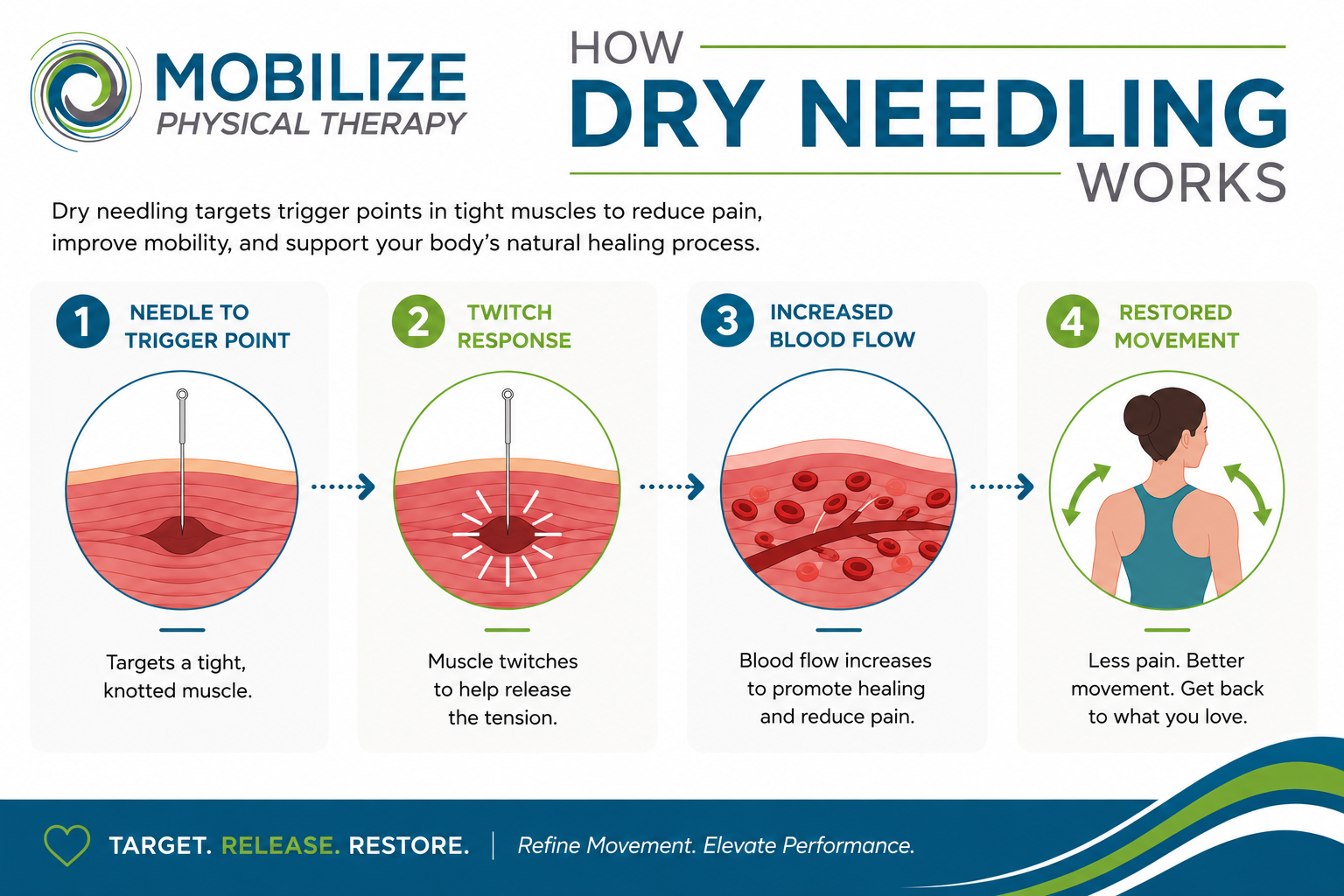
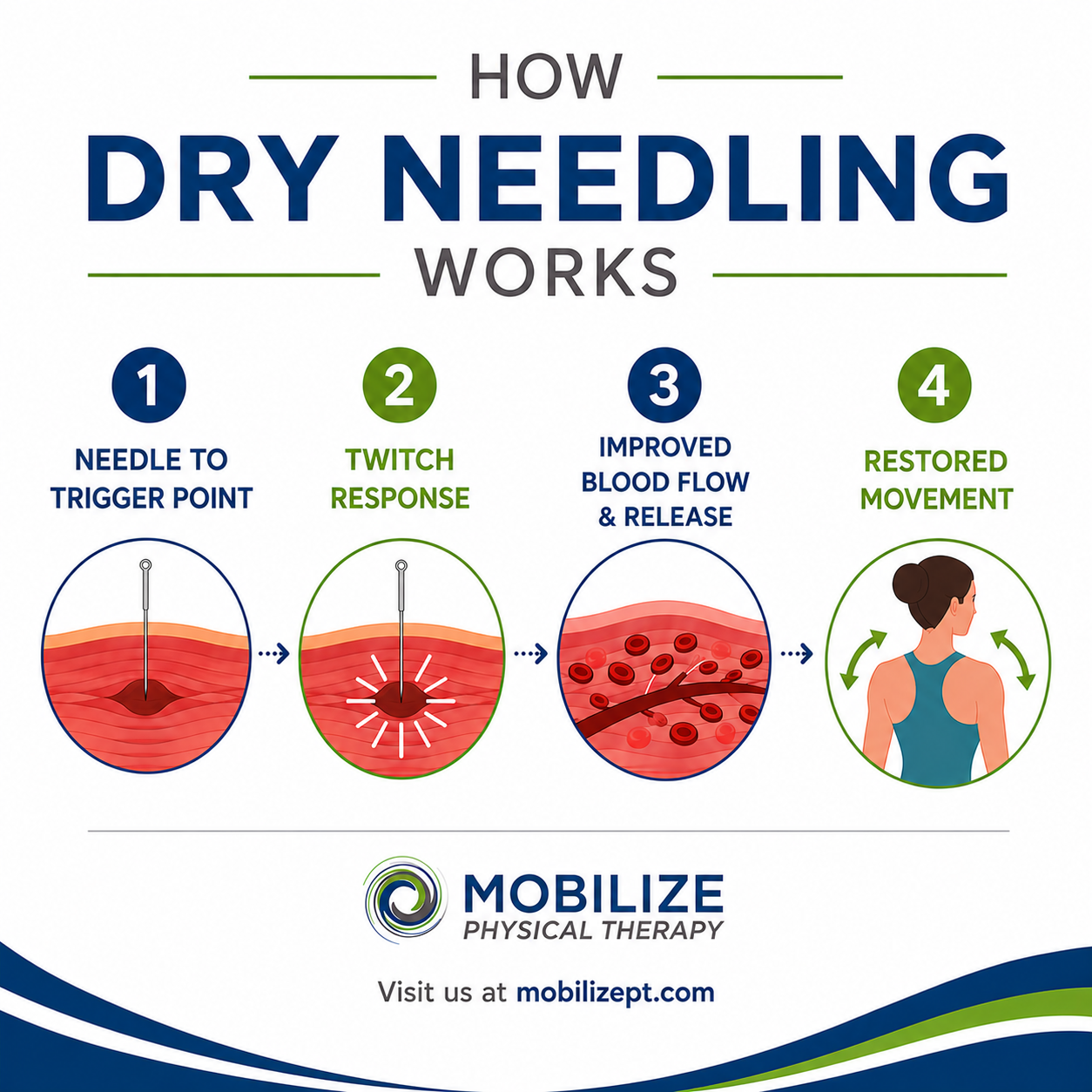
Dry needling is a treatment where a thin, sterile filiform needle is inserted directly into a tight band of muscle, known as a trigger point. The “dry” simply means nothing is injected. The needle itself does the work.
When the needle reaches a trigger point, it prompts the muscle to release. Blood flow increases, the chemical signals that drive pain and inflammation settle down, and the muscle is reminded how to relax and move freely again.
You may feel a quick twitch when a trigger point lets go. That’s a good sign. It means the muscle is responding.
It’s a Western, evidence-based technique grounded in anatomy and neuromuscular science, not the same thing as acupuncture (more on that below).
Conditions Dry Needling Can Help
Dry needling works best for pain and movement problems that trace back to tight, overworked, or irritated muscles. We often recommend it for:
- Neck pain, tension headaches, and jaw tightness
- Low back pain and hip tightness
- Shoulder pain and rotator cuff issues
- Sciatica and nerve-related tension
- Tendon pain like tennis elbow, golfer’s elbow, and Achilles tendinopathy
- Knee pain and IT band tightness
- Calf, hamstring, and other sports-related strains
- Chronic myofascial pain and stubborn muscle knots
If you’ve tried rest, stretching, or massage and the same tight spot keeps coming back, dry needling may be the piece that’s been missing.
The Benefits of Dry Needling
The biggest advantage of dry needling is that it reaches muscle tension at the source, then we put that progress to work right away.
Most patients come for relief and stay for what it makes possible:
- Less pain and muscle tightness, often after the first session
- Better range of motion and easier, freer movement
- Faster recovery when paired with hands-on therapy and exercise
- A non-invasive, drug-free option that avoids injections and medication
- Lasting results, because we treat the root cause and build strength around it
Because dry needling loosens the muscle, the movement and exercise work we do afterward tends to stick. That’s exactly why we never use it on its own.
What to Expect From a Dry Needling Session
We start by talking through your history and watching how you move, so we can pinpoint the muscles actually driving your pain. Dry needling is only used when it’s the right fit for your plan.
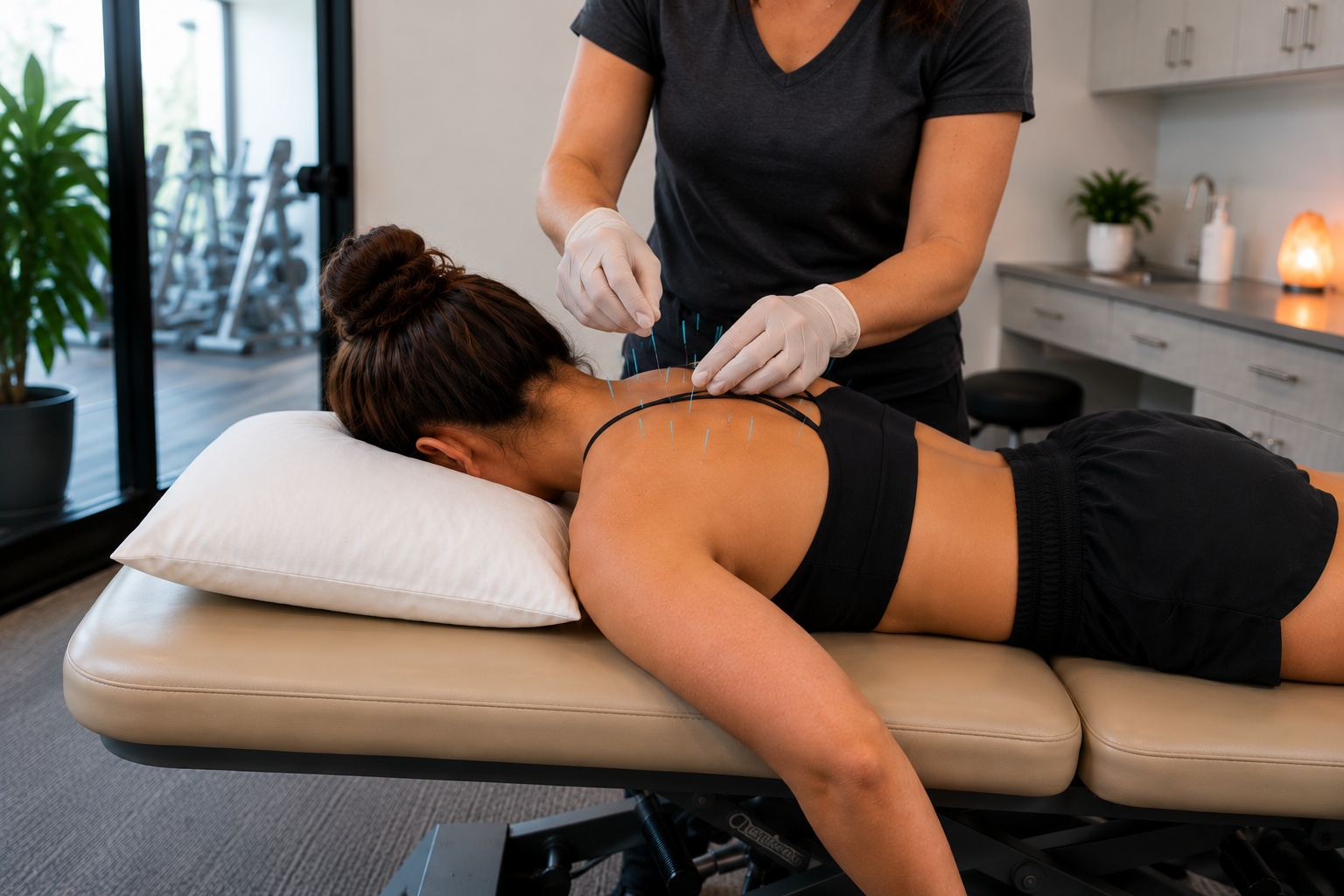
During treatment, you’ll feel the needle enter the muscle. Sometimes there’s a quick twitch or a brief deep ache as a trigger point releases. Most people describe it as an odd but tolerable sensation, not a sharp pain. We check in constantly and adjust as we go.
Afterward, it’s normal to feel a little sore, much like the day after a good workout. That usually fades within a day or two, and many people notice more freedom of movement right away.
For the best results, we’ll pair your dry needling with manual therapy, movement retraining, and a targeted exercise program, so the relief lasts.
Dry Needling vs. Acupuncture
They look similar, but they come from different worlds.
Acupuncture is rooted in traditional Chinese medicine and works with energy pathways across the whole body. Dry needling is based on Western musculoskeletal science and targets specific trigger points in muscles to relieve pain and restore movement.
At Mobilize, dry needling is always delivered by a licensed Doctor of Physical Therapy as one part of a complete rehab plan, never a standalone service.
Your Dry Needling Provider: Dr. Young Filer
Dry needling at our Seattle clinic is performed by Dr. Young Filer, PT, DPT, OMPT, OCS, a board-certified clinical specialist in orthopedic physical therapy with 25 years of experience.
Young is a trained manual therapist, certified in dry needling, ASTYM, and spinal mobilization. She blends hands-on techniques with functional movement to get the best possible outcomes, guided by a simple philosophy:
Available in our Laurelhurst, Seattle location along Sand Point Way.
Learn more about Dr. Young Filer »
Why Choose Mobilize Physical Therapy
At Mobilize PT, dry needling isn’t a standalone service. It’s part of a complete, individualized plan. You’ll always work one-on-one with a Doctor of Physical Therapy for a full 45 minutes, never an aide or assistant.
We combine dry needling with hands-on manual therapy, movement retraining, and targeted exercise, so you’re not just feeling better today. You’re building the strength and resilience to keep the pain from coming back.
That’s the difference of one-on-one care from a small, local, PT-owned practice.
Frequently Asked Questions
Does dry needling hurt?
Most people feel a small prick as the needle enters, and sometimes a quick twitch or brief ache when a trigger point releases. It’s usually described as odd but tolerable, not sharp. We adjust throughout to keep it comfortable.
Is dry needling the same as acupuncture?
No. Acupuncture comes from traditional Chinese medicine and works with the body’s energy pathways. Dry needling is based on Western anatomy and targets muscle trigger points to relieve pain and restore movement.
How many sessions will I need?
It depends on your condition and goals. Some people feel meaningful relief after one or two sessions, while longer-standing issues take several. We’ll map out a realistic plan at your first visit.
Is dry needling safe?
Yes. We use single-use, sterile needles. In Washington, dry needling is performed by physical therapists with state-approved, Department of Health-endorsed training, always as part of a broader treatment plan.
Will I be sore afterward?
Mild soreness for a day or two is normal, much like after a hard workout. It typically eases quickly, and many people notice better movement right away.
Ready to Move Better?
If a stubborn knot or nagging pain has been holding you back, let’s find out whether dry needling is the right fit for you. We’ll talk through your history, your goals, and the plan that gets you back to the activities you love.
Schedule your appointment today, or call (206) 402-5483 to get started.